

Every professional kitchen shares the same quiet bottleneck: staff constantly walk away from the prep line to fetch ingredients from a distant walk-in cooler. Each trip steals seconds, breaks concentration, and — when the walk-in is crowded or far away — tempts cooks to leave perishable items on open counters, where they drift into the temperature danger zone. A counter-height refrigerated unit solves this by putting chilled storage directly beneath the surface where food is assembled, portioned, and plated.
Yet choosing one is not as simple as picking the largest cabinet your budget allows. Commercial kitchens face health inspections, tight floor plans, and energy bills that run year-round. A unit that is too small forces overloaded airflow and warm pockets; one that is too large wastes money and square footage. Buyers who skip the homework often discover the consequences weeks later, in spoiled inventory and service calls.

To choose the right commercial counter refrigerator for your kitchen, define your daily food volume and available floor space first, then evaluate temperature performance, build quality, climate class, energy efficiency, door configuration, and how the unit fits your prep workflow — and verify compliance with recognized food safety standards before you commit.
The sections below walk through what these units actually do, the factors that separate a dependable workhorse from a costly mistake, how counter models compare with related chilled and frozen equipment, and the maintenance habits that extend service life. Use the checklists as a practical starting point for your specification, and you will narrow the field quickly.
What Is a Commercial Counter Refrigerator
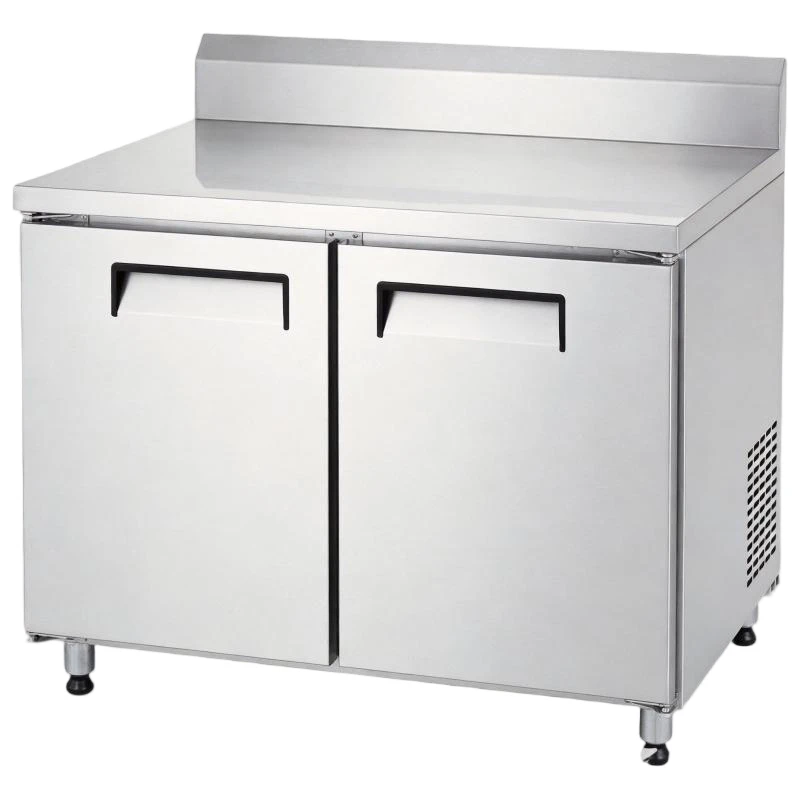
A commercial counter refrigerator is a self-contained refrigerated cabinet built to worktop height, providing chilled storage beneath a durable stainless steel work surface that supports everyday prep activity.
Most models stand roughly 27 to 34 inches tall, which aligns with standard prep tables and serving counters, and offer between 4 and 15 cubic feet of storage depending on width and door count. The interior is kept between roughly 33°F and 41°F (0.5°C to 5°C) — cold enough for dairy, produce, sauces, dressings, and proteins awaiting preparation. The top surface is typically 18-gauge or 16-gauge stainless steel, able to handle cutting boards, full-size sheet pans, and small equipment.
The real value of this equipment is workflow. A prep cook can keep mise en place and high-turnover ingredients inches from the cutting board instead of making repeated trips to a remote cooler. For operations that prefer to browse by product family, the full lineup of commercial refrigerators shows how counter-height models sit alongside reach-ins, prep tables, and display units — because the best choice often mixes several formats across the floor.
Key Factors to Consider When Choosing a Commercial Counter Refrigerator
Six factors matter most: storage capacity matched to peak demand, reliable temperature hold under load, corrosion-resistant construction, energy efficiency, door and pan configuration, and the ambient conditions where the unit will run.
Each factor influences a different part of your operation, from food safety to monthly utility costs, so review them as a set rather than in isolation.
Sizing and Capacity
Begin with a realistic estimate of peak inventory — the busiest day of the week, not the average. Count the pans, trays, and containers you need to hold at one time, and leave room for air to circulate stored items. Overloading a cabinet blocks airflow, forces the compressor to run longer, and creates warm spots that can compromise food safety.
A simple sizing approach works well:
- List every chilled item category used during a typical service.
- Estimate the number of full-size or half-size pans each category requires.
- Add 15 to 20 percent headroom for delivery days and menu changes.
- Measure the available floor space, including door swing and aisle clearance.
- Match the chosen cabinet volume to the larger of the two estimates.
An undersized unit hurts daily operations; a slightly larger unit with proper airflow is a better long-term investment.
Temperature Performance and Food Safety
Temperature is the single most important specification in cold holding. Verify the unit maintains food at 41°F (5°C) or below, as recommended under the FDA Food Code for cold-held foods, even when the door opens repeatedly during a rush. Ask the manufacturer for performance data and test a new unit with a calibrated thermometer before stocking it.
Ambient conditions matter as much as the thermostat. Equipment placed next to ovens, fryers, or in direct sunlight works harder to hold temperature. Climate class ratings describe the maximum ambient temperature a unit is designed to operate in — a tropical-rated unit handles hotter, more humid kitchens far more reliably than a standard-duty model. If your kitchen runs warm, this is not a place to save money.
Build Quality and Materials
Commercial refrigeration lives a hard life: constant door cycles, moisture, cleaning chemicals, and heavy pans sliding across the top. Durable materials pay for themselves over a ten-year service life.
Look for these construction markers:
- 304 stainless steel interior and exterior for corrosion resistance.
- Thick, high-density insulation to limit heat gain and save energy.
- Self-closing doors with magnetic, replaceable gaskets.
- Rounded interior corners and coved seams for easier sanitation.
- Heavy-duty casters or adjustable legs matched to your cleaning routine.
- Door locks and handles that survive high-volume use.
Energy Efficiency and Running Costs
The purchase price is only the first payment. A counter refrigerator runs continuously in most kitchens, so efficiency differences compound quickly. Condenser coils that are easy to access and clean, good gasket seals, and auto-defrost cycles all reduce energy consumption.
A practical way to compare models is total cost of ownership. Estimate purchase price, expected annual electricity use, routine cleaning and maintenance, and realistic service intervals. Paying more upfront for a better-insulated, more serviceable unit frequently beats a cheaper model that runs harder and fails sooner.
Configuration and Workflow
Match the cabinet to how your kitchen actually moves. Decide whether the doors face the prep aisle or the back-of-house pass-through area, and whether full-width doors or separate half doors better limit cold air loss during busy service. Pan capacity on the top surface is another decision point: some operations need a full worktop, while others prefer models with refrigerated pan rails for holding measured ingredients during assembly.
Ergonomics also counts. The ideal unit height keeps the work surface comfortable for standing staff and keeps the most-used shelf at waist level. Before finalizing any model, confirm that its width, depth, and height fit the planned location — including clearance for ventilation and the ability to open doors fully.
Counter Refrigerators vs. Undercounter Freezers vs. Worktop Freezers
The three formats are close relatives but serve different storage jobs: counter refrigerators hold chilled goods at 33–41°F for immediate prep, undercounter freezers hold frozen inventory at or below 0°F, and worktop freezers combine frozen storage with a usable stainless work surface in a single compact footprint.
| Feature | Counter Refrigerator | Undercounter Freezer | Worktop Freezer |
| Typical temperature | 33–41°F (chilled) | 0°F or below (frozen) | 0°F or below (frozen) |
| Primary use | Prep-line chilled storage | Frozen backup near the line | Frozen storage plus work surface |
| Top surface | Standard on most models | Varies by model | Built-in stainless worktop |
| Best fit | High-volume fresh ingredients | Kitchens with heavy frozen stock | Compact kitchens with limited space |
If chilled inventory dominates your operation, a counter refrigerator should anchor the prep line. If you also hold significant frozen product — proteins, par-baked goods, portioned items — placing frozen storage close to the line saves just as many steps. Operations in that situation should review undercounter freezers, which deliver freezer temperatures at a convenient height without consuming premium counter space.
For kitchens where floor area is the scarcest resource, the deciding question is whether one piece of equipment can serve two roles. A single unit that provides both a working top and frozen storage frees the rest of the floor for other stations. Operators with that constraint should evaluate worktop freezers alongside separate chilled and frozen units — the combined footprint is often the better trade-off in small prep areas.
Cost Considerations and Long-Term Value
Budget for the full cost of ownership — purchase, installation, energy, cleaning, and service — because a reliable, energy-efficient unit usually costs less over its working life than a cheap model that cycles constantly and breaks down at the worst moment.
Energy consumption is the hidden line item. A poorly insulated or overworked unit runs longer cycles, raises kitchen heat load, and inflates cooling costs for the whole room. Choosing efficient models with cleanable coils and tight seals keeps both the cabinet and the compressor working less.
Serviceability matters in a commercial setting because downtime costs revenue directly. Confirm that the manufacturer offers accessible parts — gaskets, thermostats, fans, and compressors — and that a local service network can respond quickly. A warranty that covers parts and labor for several years, combined with a realistic maintenance schedule, protects your operation from unexpected replacement expenses.
Maintenance Best Practices
Routine care — not occasional repair — keeps a commercial counter refrigerator holding temperature, passing inspections, and running efficiently for a decade or more.
Follow a simple, repeatable schedule:
- Clean condenser coils every one to three months, depending on kitchen dust and grease load.
- Inspect door gaskets monthly for cracks, tears, and loss of magnetic seal.
- Wipe interior surfaces with food-safe sanitizer and check for frost buildup.
- Keep the unit level so doors close and seal properly.
- Log food temperatures daily to catch drifting performance early.
- Schedule an annual professional service visit for refrigerant and thermostat checks.
None of these tasks take long, but skipping them is the most common reason commercial refrigeration fails prematurely. A written maintenance log also demonstrates due diligence during health inspections.


Final Checklist Before You Buy
Summarize your requirements in one page: peak volume, target temperatures, footprint, ambient conditions, workflow direction, and service expectations — then compare every shortlisted model against that page.
Verify the unit holds 41°F or below under load, is built from corrosion-resistant stainless steel, offers cleanable and replaceable components, and is rated for the heat of your kitchen. Confirm the size fits both the floor plan and your storage workflow, and include energy and service costs in your comparison. A disciplined specification process removes the guesswork, so the unit you install becomes a quiet asset that supports safe, efficient service for years.
Frequently Asked Questions
Is NSF certification required for a commercial counter refrigerator?
NSF 7 certification is not a legal requirement in every jurisdiction, but it is widely expected by health inspectors and many equipment buyers. It signals that a unit meets recognized standards for temperature performance and sanitation, which simplifies inspections and gives purchasers documented proof of capability. When comparing models, request the manufacturer’s certification listing rather than relying on marketing claims.
How long will food stay cold in a commercial counter refrigerator during a power outage?
A fully stocked unit generally holds safe temperatures for about four hours if the doors remain closed, because the stored food itself acts as thermal mass. A partially loaded unit warms faster. After an outage, check internal food temperatures with a calibrated thermometer rather than guessing — discard any potentially hazardous food that rose above 41°F (5°C) for more than four cumulative hours.
Can a commercial counter refrigerator be placed flush against a wall?
Most self-contained counter units require clearance for airflow around the condenser, although specific requirements vary by design. Placing the unit flush against a wall or cabinet can trap heat, force longer compressor cycles, and shorten service life. Check the manufacturer’s installation instructions for minimum clearances on the sides and rear, and keep vents and condenser areas free of obstruction.