

A 2 Glass Door Commercial Refrigerator looks like a simple purchase and rarely is. It has to hold temperature in a working kitchen or shop, show product clearly, and survive hundreds of door openings a day without wrecking the electricity bill.
Before you buy 2 glass door commercial refrigerators, settle on four things: the capacity and dimensions the space allows, including the delivery route and ventilation clearance; the cooling system, covering compressor position, refrigerant, and defrost behavior; the glass construction, covering pane thickness, coating, and condensation control; and the temperature performance and certifications that keep the unit compliant.
Each of these deserves a closer look, and the answers constrain one another.
What a Two-Door Glass Configuration Actually Gives You
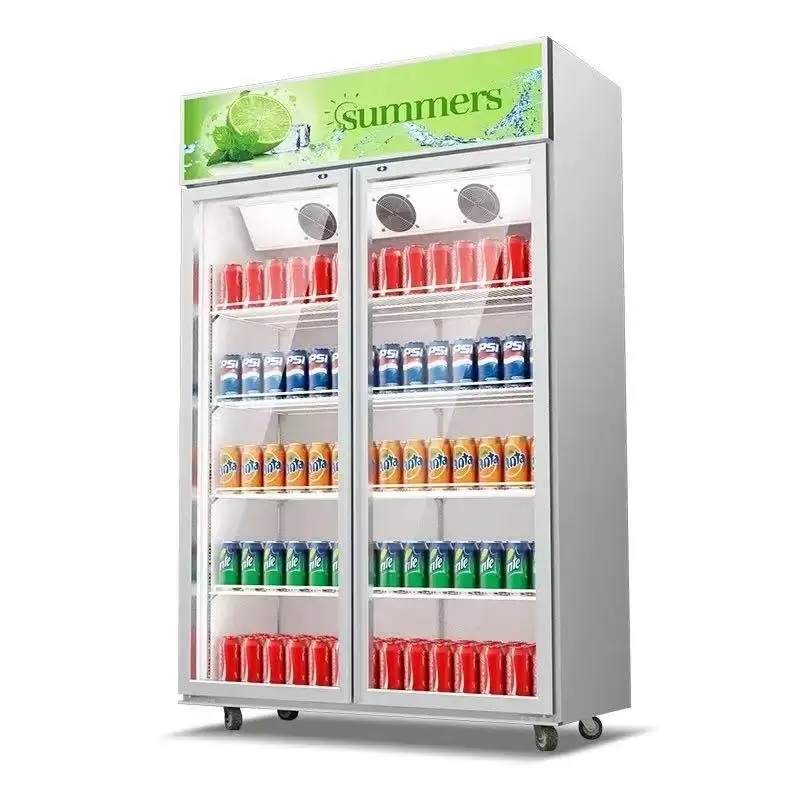
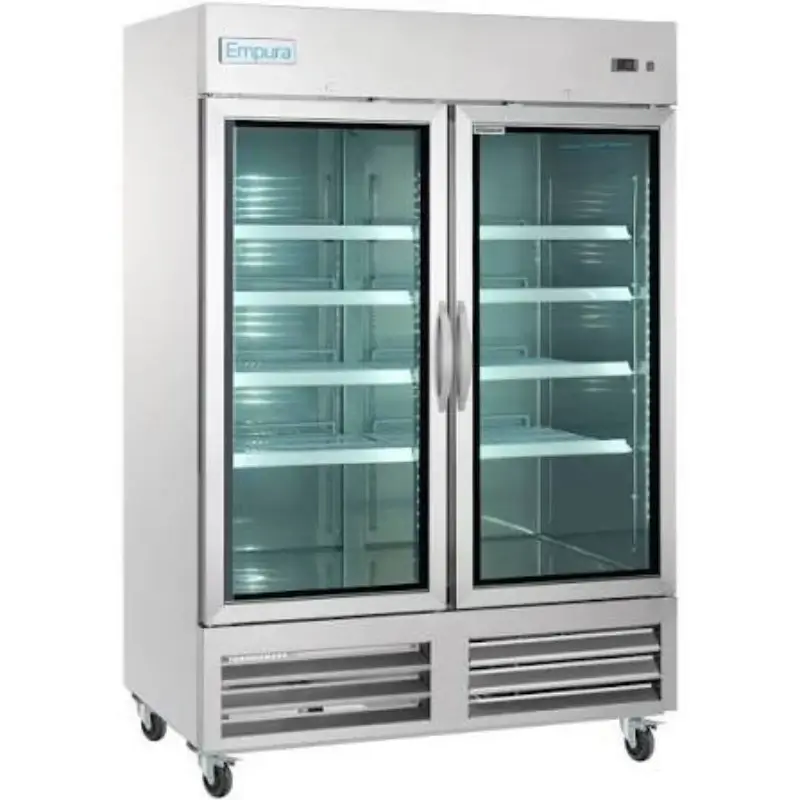
A two-door glass refrigerator is two independent door sections across one cabinet, typically 48 to 54 inches wide with 35 to 49 cubic feet of capacity, roughly double the storage of a single-door unit.
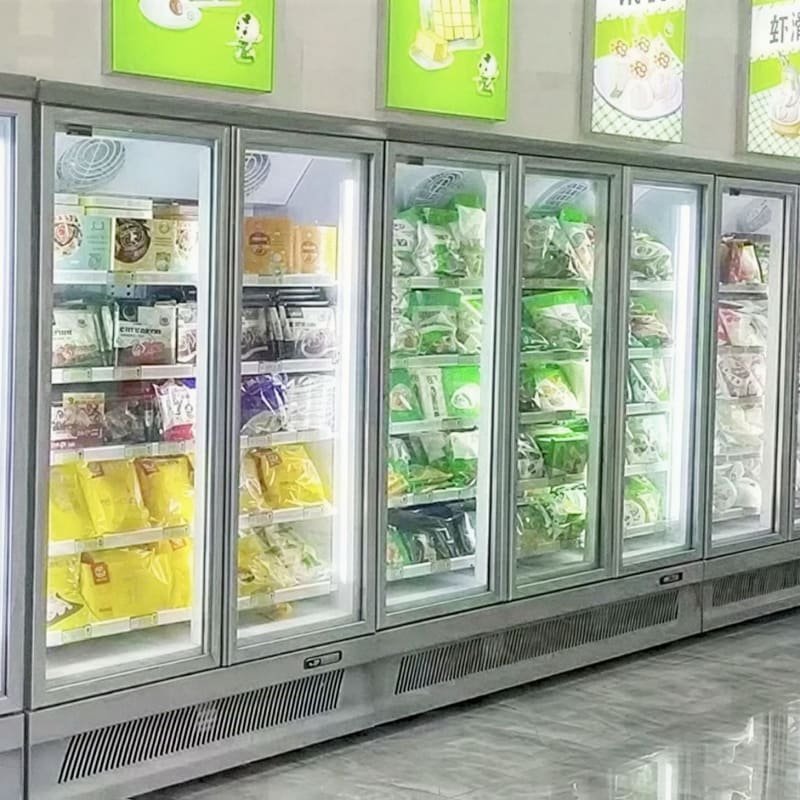
The advantage is split access: opening one section leaves the other half closed, so less cold air escapes during peak service. Two-door units suit sites where several people share a cabinet.
Two Doors Versus One or Three
| Configuration | Typical width | Typical capacity | Where it fits |
| Single door | 27 to 29 in | 17 to 23 cu ft | Cafe, bar, prep station |
| Double door | 48 to 54 in | 35 to 49 cu ft | Restaurant, store, catering |
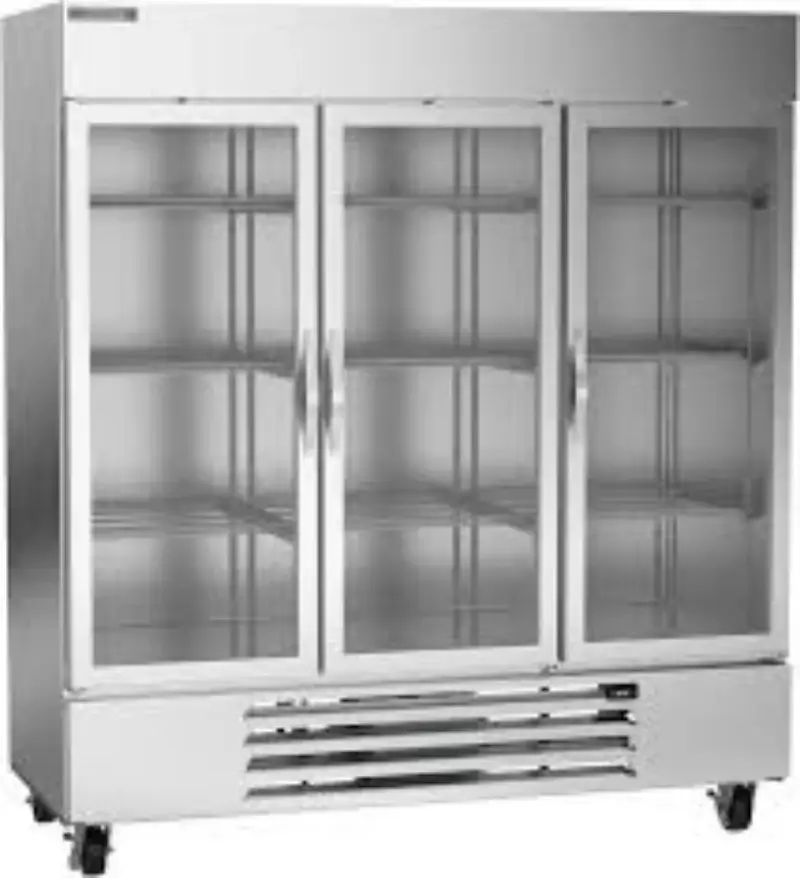
| Triple door | 78 to 82 in | 64 to 68 cu ft | High volume, banquet kitchen |
Two-door configurations are the most common working setup because they separate raw and ready-to-eat products without requiring a triple-door footprint. Confirm both sections share one refrigeration system and one power supply.
The Trade-Off That Comes With Glass
Glass conducts heat far more readily than an insulated solid panel, which matters wherever ambient temperature is high. Glass door units work best in front-of-house display and air-conditioned back areas. On a hot line, a solid door unit holds temperature with less effort.
Capacity, Dimensions, and Whether It Will Fit
Read capacity as usable volume rather than a headline number, then measure the route into the room as carefully as the space inside it, because a cabinet that cannot pass the doorway cannot be installed.
Reading Capacity Numbers the Useful Way
Advertised capacity is gross interior volume. Shelf thickness, the evaporator housing, and the airflow gap the manufacturer requires all reduce what you can load. Ask for the shelf count, the load rating per shelf, and whether the unit accepts full-size food pans. Eight shelves rated near 90 pounds each behave differently from four weaker ones.
Measuring the Route and the Clearances
Record the cabinet dimensions, then add the door swing radius, the ventilation clearance at the rear and top, and the service access a technician needs. Measure the delivery path too: doorway widths, corridor turns, and overhead restrictions. Blocking condenser airflow raises running costs and can void the warranty.
How the Cooling System Works and What to Ask About
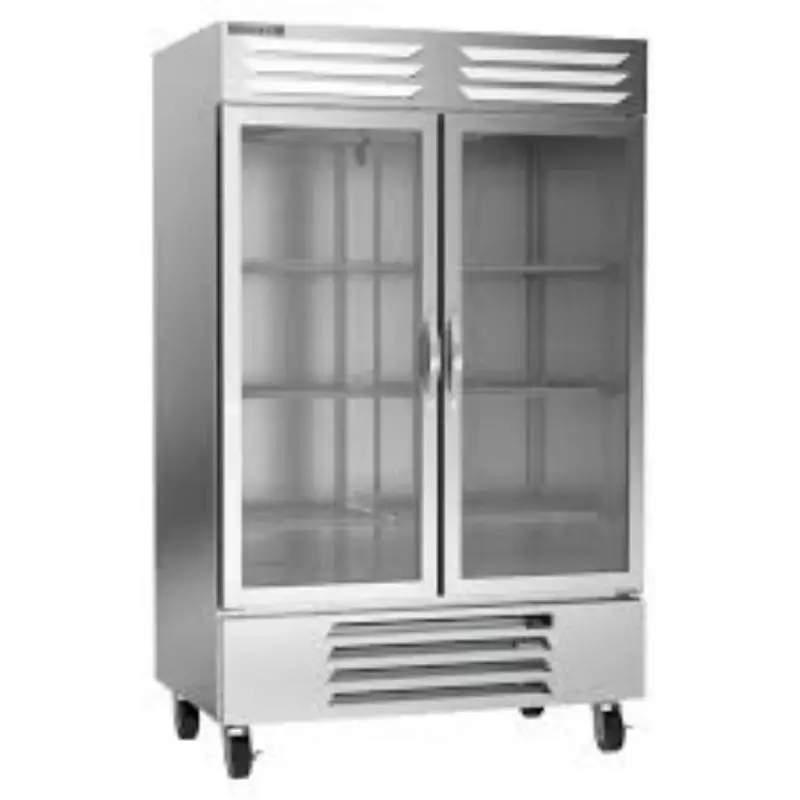
Ask where the compressor sits, what refrigerant it uses, and how the unit defrosts, because those answers determine maintenance effort, regulatory compliance, and behavior in your climate.
Compressor Position, Duty, and Ambient Rating
A bottom-mounted compressor sits in the coolest air in the room and is easy to reach for cleaning, but it collects more floor-level dust and grease. A top-mounted unit keeps the base clear but demands a stepladder for service. What matters more is the rated ambient temperature, because a cabinet rated for a mild climate struggles to hold a set point in a hot kitchen.
Refrigerant, Defrost, and Airflow
Modern cabinets run on natural refrigerants such as propane and isobutane, each with use conditions covering charge size, ventilation, and technician certification. Under the EPA Significant New Alternatives Policy, higher warming refrigerants are being phased down, so the refrigerant on the nameplate affects compliance and resale. Ask about the defrost cycle, since timed electric defrost runs regardless of need, and whether the fan stops when a door opens.
Glass Door Construction, Gaskets, and Condensation
The door is where most heat enters and where most complaints start, so confirm pane construction, coating, sealing, and lighting before you order.
Tempered, Double-Pane, and Low-E Glass
Commercial doors use tempered glass because it resists impact and breaks into blunt pieces rather than sharp shards, which matters on a busy floor. Double-pane construction with a low-emissivity coating reduces heat transfer, and in humid climates, a heated pane prevents fogging and dripping onto stock. Confirm interior LED lighting is included.
Self-Closing Hinges, Locks, and Gaskets
Self-closing hinges return the door to a sealed position after each opening, protecting food safety and energy use. Magnetic gaskets that pull out without tools make sanitation checks quick, and locks matter wherever stock is valuable. Ask how many cycles the hinge is tested for and whether replacement gaskets are a stocked spare.
Temperature Control, Food Safety, and Compliance
A refrigerator is compliant when it maintains safe temperatures under real working conditions and has records to prove it, so ask for the operating range, recovery behavior, and certificates that cover your market.
Set Point Versus Real Performance
Glass-door refrigerators typically hold between 33 and 41 degrees Fahrenheit, roughly 0.5 to 5 degrees Celsius. That range is not the same as performance. What matters is how quickly the cabinet recovers after a door closes on a warm day and whether it holds temperature at your peak ambient level.
Certifications Worth Verifying
| Certificate | What it covers |
| Food equipment sanitation standard | Cleanability, material safety, temperature uniformity |
| Electrical safety listing | Wiring, grounding, and overload protection |
| Energy efficiency certification | Verified consumption against a baseline |
| Refrigerant compliance | Charge size, labelling, and service requirements |
| Regional electrical mark | Legal sale and installation in the destination market |
Certificates must name the model and the manufacturing site. Please provide copies that include validity dates and confirm they still cover the unit if you specify custom shelving.
Matching the Unit to How You Will Use It
Choose the cabinet from the door-opening pattern and the products it will hold, not from the product photograph, because display duty and storage duty push the specification in opposite directions.
Front of House, Retail, and Back of House
Front-of-house and retail units prioritize visibility: full glass doors, bright lighting, and a shallow depth that lets customers reach the back row. Back-of-house units prioritize thermal retention, so they tend toward solid doors and deeper shelving. The simplest way to choose is by considering door openings per hour.
Shelving, Loading, and Product Segregation
Plan the internal layout before delivery. Adjustable shelves let you separate raw proteins from ready-to-eat items, which is standard food safety practice, and leave room to rotate stock first in, first out. Please confirm the shelf load rating for your heaviest cases.
Running Cost and Maintenance You Should Plan For
Expect to pay for energy and upkeep, not just the purchase. Running cost is driven by ambient temperature, door openings, defrost cycles, and the efficiency rating, and it usually exceeds the purchase price over the asset life.
What Drives Energy Consumption
| Factor | Effect on consumption |
| Ambient temperature | Hotter surroundings raise compressor run time |
| Door openings per hour | Each event admits warm, humid air. air |
| Heated or low-E glass | Small continuous load, large reduction in condensation |
| Defrost cycle frequency | Timed electric defrost uses energy regardless of need |
| Efficiency rating | Verified performance against a published baseline |
Where a verified figure exists, such as the listings published through the ENERGY STAR program, apply your electricity rate and expected operating hours, then multiply across the years you keep the unit.

The Maintenance Routine That Protects Performance and Warranty
Clean the condenser coils monthly in dusty or greasy kitchens, because a dust layer reduces heat transfer and forces the compressor to run longer. Check door gaskets quarterly and calibrate the thermostat annually. Keep the drain line clear and register the warranty, since registration often extends compressor coverage.
FAQ
Can a two-door glass refrigerator be used for back-of-house storage?
Yes, and plenty of kitchens do, provided the unit is rated for the ambient temperature and the gaskets seal in a hot, humid environment. The caveat is energy: a glass front transfers more heat than a solid panel, so the compressor works harder. Where visibility adds no operational value, a solid door cabinet costs less to run.
Why does condensation form on the glass, and how is it controlled?
Condensation appears when warm, humid air meets a surface colder than its dew point, which is why glass doors fog first in humid conditions. Door heaters, low-emissivity coatings, double-pane construction, and room ventilation all reduce it. If a door drips onto stock, check the gasket seal and room humidity.
How much does a two-door glass refrigerator cost to run?
Model the annual consumption figure against your electricity rate, then multiply by the years of service. A two-door cabinet drawing around 3 to 5 kilowatt-hours per day sits near 1,100 to 1,800 kilowatt-hours a year, making energy a larger lifetime cost than the purchase price.